
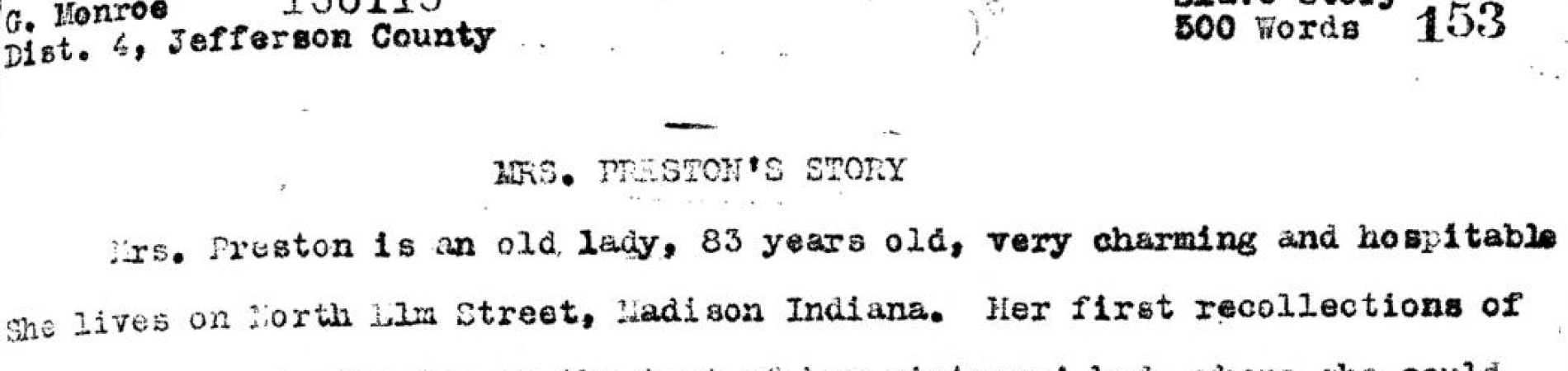
At the age of 83, Amanda Preston sat down in her home in Madison, Indiana and recounted her experiences of enslavement to the WPA. As a girl she was enslaved in Kentucky by the Browns, but her page and a half recollection is only part of her story. While her childhood was marred by slavery, Amanda lived the majority of her life as a free woman where she was a beloved daughter, wife, mother, and community member.
Amanda Nichols was born between 1855-1857 and grew up enslaved to Mason and Mary Yoder Brown. In her oral history she recalled one of her first jobs was sleeping at the foot of Mary’s bed to keep the fire burning through the night. She was “promoted” to the farm when she was older, driving cattle and hauling corn, where she worked barefoot or in ragged shoes.
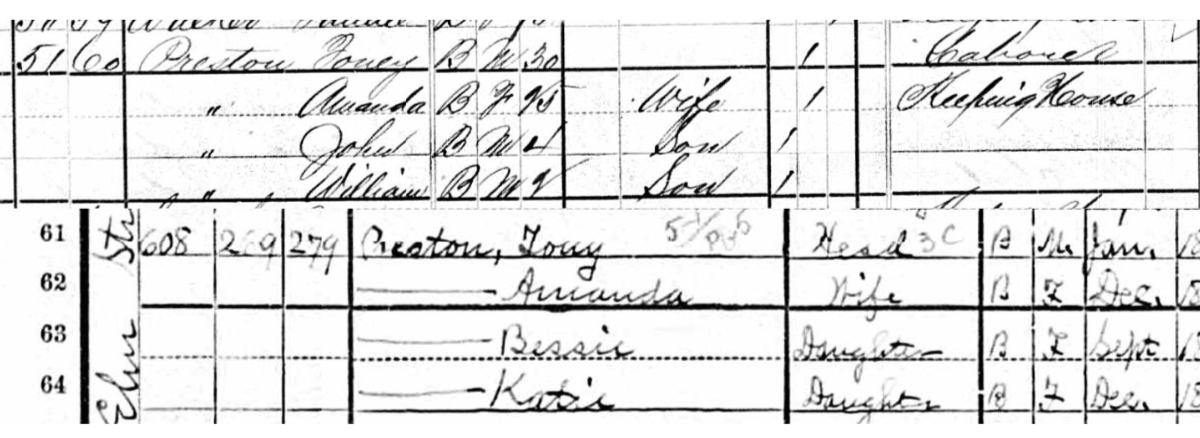
The Civil War ends in 1865, and the Brown’s gave Samuel Johnson—Amanda’s father— a house, land, and the resources to begin farming themselves. The Johnson Farm was across the Kentucky River from Brown’s Bottom in Lockport. On the 1870 Census, Amanda was 15 and lived with her parents, Samuel and Betty, and eight brothers and sisters. Between 1870 and 1880, The Ku Klux Klan threatened the Johnsons and told them to leave their home in Lockport or face violence or even death. For their safety they relocated to Madison, Indiana.
Madison is where Amanda met Toney Preston, and while we don’t know how they met, the couple married in 1875. So, when the Johnsons moved back to Kentucky, Amanda and Toney stayed in Indiana which is reflected in the 1880 census. Two of Amanda and Toney’s sons, John and William, were also listed on that census. Their third son, Julius, would have been included but he sadly passed away at the age of two a couple months before the census was taken. The Prestons had two other children Bessie and Katie, who are present on later census records. However, Toney’s obituary indicates that they had ten children meaning that the other five were stillborn or like Julius, passed early in childhood. Death seemed to follow the Prestons because in the span of three years Amanda and Toney would lose William, John, Bessie, and Katie.
John and William (and likely Bessie and Katie too) attended Broadway High School in Madison. The Broadway School first opened in 1880 as a school for Madison’s Black children but later expanded to include a high school in 1898. John and William were likely part of the first cohort to attend Broadway Highschool. While they were there the brothers were involved in choir in 1898 were featured in the Madison Courier for a recital held at another school where William performed a solo and as part of a quartet with John.
While still in school William married Eleanor Allen. The following year, in 1899, William became a teacher and was the only new Black teacher appointed that school year. Curiously he is not listed on any list of teachers for the Broadway school or high school, although does attend the Teachers Association Conference of that year. His life was sadly cut short by consumption,today known as tuberculosis, just after the start of his marriage and career in 1900. He was buried in the Preston’s family plot in Madison’s historic Springdale Cemetery.
John Evangelist Preston was one of four students who graduated from Broadway High School in 1899. There he performed a solo titled “Opportunities and Possibilities” which reflected his school career in choir and theater. In 1895 John was featured in the Madison Courier for his acting in Down in Alabama. Described as a “romance of southern life” the play featured characters that played into racist stereotypes of the time, but the talents of the black actors like John were praised. After graduation he worked as a laborer before he passed in 1902 from tuberculosis.
Research is still ongoing to learn more about Amanda and Toney’s daughters, Bessie who died in 1902 from TB and Katie who died in 1903 from unknown causes.
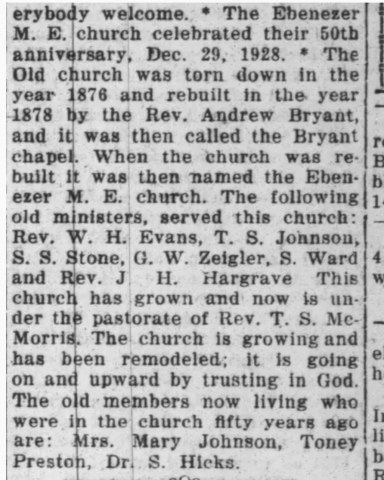
After their children’s deaths the Prestons became more involved in their communities. They become active members of their church and organizations like The Prince Hall Masons and The Grand United Order of Odd Fellows, which are both historically Black fraternal organizations. In his obituary from 1934, Toney was remembered by the congregation of Ebenezer M.E. and his Masonic Lodge as Father Preston who was “always giving comfort, ready and willing to give advice and to help in time of need (Madison Courier, 12 Nov 1934).” Amanda was also a member of the Odd Fellows, but in the women’s auxiliary group called The Household of Ruth. In 1917 she was elected as Vice Chairman and had the opportunity to travel to Indianapolis for a Household of Ruth conference. It’s likely that Amanda, like Toney, was a respected member of these organizations and was also a kind, helpful, and caring person.
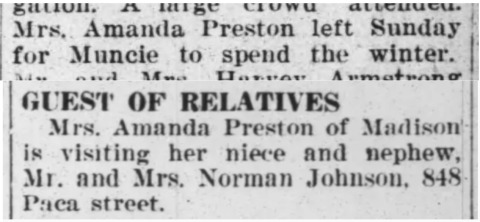
Toney died in 1934 and was buried in Springdale cemetery in the Preston family plot with no marker. Amanda lived for twenty more years as a widow, but she was not alone. Newspaper arrivals and departures indicate that Amanda visited Indianapolis semi-frequently in the 1930s. One arrival from 1935 notes that she was visiting her nephew Norman Johnson and his wife. Norman was likely the son of Lewis Johnson, one of Amanda’s brothers.
In 1936, Amanda invited Grace Monroe from the WPA into her spotless home on Elm Street in Madison where she talked about her limited memories of enslavement. Grace called the oral history, Mrs. Preston’s Story, but it was only a small portion. Amanda lived a full life in freedom following The Civil War and what is presented here is meant to offer a fuller picture of Amanda’s story
Liberty Hall staff are continually researching The Prestons and The Johnsons, and more updates will be available on the Liberty Hall Blog soon. Amanda’s WPA narrative is available on Liberty Hall’s blog and on the Library of Congress website.